 gaetano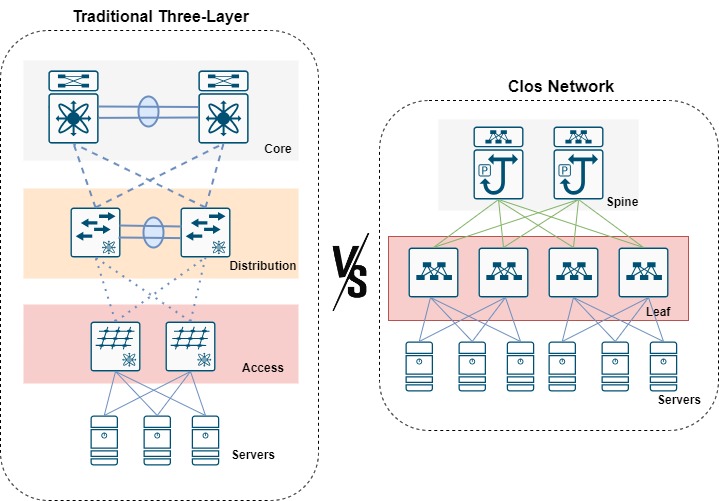
Traditional Three-Layer Architecture
The traditional three-layer network model has been the cornerstone of enterprise and data center design for decades. It consists of:
- Access Layer: Edge switches connecting end devices (servers, workstations)
- Distribution Layer: Aggregation switches providing policy enforcement and service insertion
- Core Layer: High-capacity switches providing the backbone connectivity
Limitations of Traditional Architecture
While this model served well for many years, it presents several critical limitations:
- Aggregation Bottleneck: Traffic from all access switches converges at distribution switches, creating congestion points
- Complexity: Spanning Tree Protocol (STP) and complex VLAN hierarchies increase operational overhead
- Inefficient Utilization: Only one active path per VLAN due to STP blocking constraints
- Convergence Issues: Slow recovery from network failures due to STP recalculation
- Unused Links: Many redundant links are blocked, wasting capital investment
- Suboptimal Forwarding: No Equal-Cost Multi-Path (ECMP) within the same VLAN
- No ECMP Across VLANs: Traffic between VLANs cannot leverage multiple paths
- Traffic Storm Risks: Broadcasting within large VLANs can overwhelm networks
- No Dual-Homing: Servers cannot actively use multiple connections simultaneously
- VLAN Limit: Maximum 4K VLANs constrains scalability (12-bit tag)
- Management Complexity: Requires deep networking expertise for configuration and troubleshooting
Clos Network Architecture
The Clos topology, also known as leaf-spine, addresses these limitations through a scalable, non-blocking design:
- Leaf Switches: Access points for servers and endpoints
- Spine Switches: Core fabric providing full mesh connectivity between all leaves
- Overlay Network: VXLAN encapsulation decouples logical topology from physical transport
Clos Architecture Advantages
- Scalability: Mathematically proven to scale with number of ports
- Full Redundancy: Every leaf has a path to every spine, eliminating single points of failure
- Low Latency: Consistent latency across all leaf-to-leaf paths (maximum 2 hops)
- Simplicity: No STP, simpler ECMP-based forwarding
- Resource Utilization: All links actively carry traffic (no STP blocking)
- VXLAN Overlay: Supports unlimited VLANs (24-bit VXLAN Network Identifier)
- Multi-Tenancy: Logical isolation through overlay networks
- Standardized Design: Consistent, predictable topology
Comparative Analysis
| Aspect | Traditional 3-Layer | Clos (Leaf-Spine) |
|---|---|---|
| Scalability | Limited by core capacity | Linear with spine count |
| Redundancy | Single path per VLAN | Multiple active paths |
| Latency | Variable (up to 4+ hops) | Consistent (2 hops max) |
| Convergence | Slow (STP recalc) | Fast (IP routing) |
| Link Utilization | Low (STP blocks) | High (all links active) |
| VLAN Support | 4K max | 16M+ (VXLAN) |
| Management | Complex | Simplified |
Conclusion
The transition from traditional three-layer architectures to Clos-based designs represents a fundamental shift in data center networking. By leveraging VXLAN overlay networks and simplified routing protocols, organizations can build larger, more scalable, and more resilient fabrics with consistent performance characteristics. This architecture has become the industry standard for modern cloud and enterprise data centers.